Sunday, November 3, 2013

The Battle

This week in class we had our own wrestling match. 

The Chacham starts off with his argument responding to the Yirei Elokim from Perek 7: You can only find meaning through wisdom. You get wisdom, intellect, morals and values from yourself. 

Then the Yirei Elokim comes back to defend himself: He says that he is like the Chacham in that he uses wisdom-the difference though is that the source of his wisdom is all from G-d. You are obedient to G-d, you can't escape Him. You can't tell G-d what to do and death will come to everyone. Ultimately everyone will be accountable and judged for their actions.

The Chacham comes to fight back next: In a sarcastic way he is critical of the system whereby people are not held accountable until death. He encourages people to be in this world because they don't see that people are actually punished. 

The Yirei Elokim comes back to finish the round: He responds to the Chacham-G-d has a reason for prolonging Mishpat. It allows the wicked to repent. But, ultimately if a person is G-d fearing he will be rewarded and if wicked will be punished. 

In my opinion, I think that the Yirei Elokim has better points. His answers seem more logical to me. Because, there is a G-d and there is such thing as reward and punishment and I agree more with the Yirei Elokim. I think the Chacham is just so obsessed with wanting to be right and not wanting to believe things he can't see, he can't look further into things. 

Who do you think won this match?


In פרק ח the ירי אלוקים and the חכם get involved in a heated argument. This back and forth conversation explains their views of חכמה. The חכם thinks that man has to work for his wisdom, and it is the only thing that will make life meaningful. The world can not be understood without חכמה. He is extremely arrogant at this point. He says, "Who is better than a wise man (me)?" 

The ירי אלוקים responds by saying that the חכם is not the only one who uses wisdom. He has knowledge too because he is obedient to G0d. He is saying that the source of wisdom comes from the value of G0d. The ירי אלוקים is trying to explain the to חכם why being religious like him is valuable and helpful. 

In my opinion both of these values are important to understanding the value of wisdom. You cannot just gain knowledge without working for it. Being religious definitely can help gaining knowledge, but you cannot just sit around waiting for G0d to pop the information into your head. You have to work for it and want it. Especially at our age this can help us gain incentive to work harder to learn. 

The Chacham and Yirei Elohim

While I was looking through Calvin and Hobbes Comics this week, I got overwrought with indecisiveness. So I finally decided- I'm going to make this whole post comics and explanations of how they relate! We're almost done with Kohelet, can you blame me? I'm not quite sure C&H comics will be applicable when we learn about Esther or any of the other megillot. On that note, let us begin (in no particular order):

This one reminded me of the chacham. It got me thinking about wisdom. Once you start knowing everything, you start seeing seeing how complex everything is. The more you learn, the more you realize that "nothing is as clear and simple as it first appears". The Chacham wants to learn more and understand everything, but can he? Everything is so complex, and nothing is ever simple- are there really answers out there? This is also a little reminiscent of the nehaneh- "knowledge is paralyzing" because we don't have the capacity to understand it, so why not just be "ignorant". What do you guys think about being informed and wisdom? Is there a way to be happy once you know more? You know the saying "ignorance is bliss"? Well, it's not so famous for no reason. It's easier to be less informed sometimes, because truths do get harsh. But on the other hand, isn't it better to be out of the dark, even if it means being a little sad about it? What do you guys think?

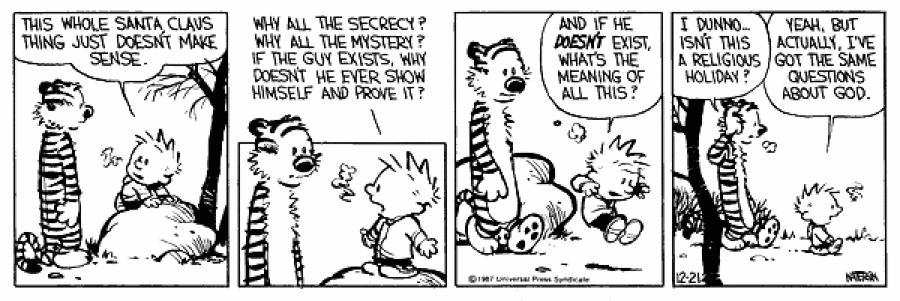
There are some really good X-Mas ones that can be applied in a broader sense to any religion. This also reminded me of the Chacham. The "Why all the secrecy? Why all the mystery? If the guy exists, why doesn't he ever show himself and prove it?" monologue sounds like the Chacham when he's being critical of the system whereby people are not held accountable for their actions. According to the Chacham, nothing happens to wicket people in this world and this is a flaw. The catch with this philosophy is that it can lead to the next 2 frames- What is the meaning of this? How do we know there is a God? What do you guys think? Too grim? Do you see the correlation or did I just make that one up? Is Santa Clause real? What makes Santa more or less real than anything else? 

This one reminded me of Pascal's wager. Not directly related to this specific text, but it is something we discussed when talking about Philosophy. What is your take on Pascal's wager? I guess this solves the Santa question! Calvin-and-hobbes

This reminds me of the person that the Chacham was referring to in passuk tet when he says that he sees a system in which people are encouraged to be evil because they don't see that they are being punished. I feel like these guys are like, you know what "I don't believe in ethics anymore" because I don't see anyone being punished. So let me do what I want. What do you guys think about ethics? Inherently human? Need God to have ethics? Do you agree with the Chacham about the flaw, or do you agree with the Yirei Elohim? Explain your answer. 

CS Lewis and the יראי אלוקים (Oh and this is basically one big spoiler)


I was reading the last book of the Chronicles of Narnia (The Last Battle) on Shabbos, and I found something I thought was pretty interesting.
I don't know how many people have read this particular book, but (SPOILER ALERT!!!) at the end of it, all the good creatures come out of Narnia, and Narnia is destroyed. There is a big battle, and in the midst of it are a group of dwarves who are only "for the dwarves." They don't care who wins the war: the Narnians or their enemies. They only care for themselves. They also seem to think very highly of their own intellects. Sound familiar?
I'm not really making any sense explaining what's going on in the book, but if anyone actually cares enough to want to read it to figure out what's really going on, I have the book, and you can borrow it. Also, here are pictures of that pages with what I'm talking about:


The part that grabbed my attention was that this group of dwarves made it into "Aslan's Country", meaning to say that they escaped the destruction of their world, but they couldn't appreciate any of it because they didn't even realize where they were. (You should really read it, cuz I'm completely messing it up.) Anyway, the dwarves think that they're stuck in a dirty stable with dirty water and rotten horse feed, when really they're in heaven with amazing food and drinks in a beautiful meadow. Everyone tries to convince them of this, but they don't believe any of it. Eventually Aslan just tells everyone trying to convince the dwarves that "[t]hey will not let us help them. They have chosen cunning instead of belief."
Finally getting to the point at hand, this seems to be a direct contrast between the חכם and the יראי אלוקים. CS Lewis seems to think that belief is more important than knowledge, or in his words, "cunning". Perhaps to him, the יראי אלוקים is the one who knows what's going on, and the חכם will be unable to appreciate anything, in this world or the next, because of his need for validation through his own intellect and experience.
I don't know if any of that made sense to anyone, but when I noticed that, I wanted to get it out there to see what other people thought.... so lemme know!

The Ultimate Question

The Chachum and the Yirei Elokim have it out in perek 9. Both bring up very reasonable arguments about faith and good and evil. First they fight over the source of wisdom. While they both agree that wisdom must be used to find meaning in life, they disagree over where that wisdom stems from. The Chachum says that his wisdom comes from his own knowledge, intellect, and morals while the Yirei Elokim maintains that all wisdom comes from G-d. G-d is the only one who knows what is moral, because morality comes from Him. Therefore, the Yirei Elokim explains that we must be obedient to G-d because we are accountable for our actions and will be judged by Him. The Chachum finds this to be ridiculous. He asks how it makes sense that people are judged only after they die? This encourages people to be evil because they don't see man getting judged or punished for his actions. Both attempt to answer the question of whether or not man is accountable for his actions. And why is this such a hotly debated topic? Because everyday we see bad things happening to good people and good things happening to bad people. What's the point of being good if bad things will happen to you anyway? Is there even a God if that happens? Why do bad things happen to good people (and vice versa)? This is the underlying question that the Chachum and the Yirei Elokim struggle with.

I am going to give some possible solutions to this incredibly difficult issue in Judaism. This question alone can make or break a person's faith. Many people turn away from G-d after a tragedy, wondering how G-d could let this happen. Last year, in Jewish Life & Faith, we did a whole unit on this one question. I will give one or two answers that I liked the most that we came up with. I will also give the answer that the Yirei Elokim gives the Chachum in pasukim 12-13. Lastly, I will offer a solution that I have just found online after some research. Many answers are given, but this one I felt was the best.

1) From The Yirei Elokim- His answer is less of an answer to the question I posed above, but more to why we should even try to be good people when it does not even seem like they get any reward for it in the end. After all, we see bad things happening to good people and good things happening to bad people so why shouldn't we just sin? He answers the Chachum in pasukim 12-13 by saying that G-d does have a reason for prolonging Mishpat. You might think that just because we are not judged till after death that there is no reason to be good and follow the mitzvot, but that is not the case. Judgment is prolongs judgement because He is giving the wicked a chance to do Teshuva. In the end, though, the G-d fearing people are rewarded and the wicked are punished.

2) From JL&F- Two of my favorite answers that we read in this class came from the Malbim and Ramban. These are two of the more famous answers to this question. The Malbim explains that there is no instant gratification in Judaism. Like we talked about in class, we are not struck by lightening the second we do something wrong and we are not given $1,000 when we do something right. Some people feel like this way might be better..then at least we'd know when we did something wrong/right and people would be more willing to do the right thing. The Malbim explains that that is not the ideal situation, though. The world is set up this way for a reason. If the world was set up like this (with instant gratification) then people would not do the right thing for the sake of G-d/because G-d told them to, they would just do it out of fear of getting punished. There would be real significance or value to doing the right thing--all people would do it just to get the instant reward and therefore the number of actual good people would be fewer. In the end, all wicked people are punished and all righteous people get their reward--even if they have to wait for it (similar to what the Yirei Elokim said).

The Ramban also gives an interesting answer. Similar to the Chachum, he says that all people sin. Even the people we call "good" have sinned before. And as we all know, when we sin we get punished. The opposite is true as well. All people do good. Even the people we call "bad" have done some good at some point. And if we do good, we will be rewarded. Since all people sin, all people must be punished at some point and since all people do good deeds, all people must be rewarded at some point. Since Olam HaZeh is finite (doesn't last forever), it is better for the good people to be punished there and rewarded in Olam HaBah where their rewards will be infinite. Evil people will get their rewards in this world where their rewards will only be ephemeral, but their punishments will be carried out in Olam HaBah where they will be infinite.

3) From Rabbi Aron Moss- Rabbi Moss has a very interesting response to this question. Rather than giving an answer, he asks another question. Why would you want to know the answer? He says that you are better off with the question than the answer. All people should be bothered by this question, and it would be even worse if we weren't bothered by it. When are people not bothered by something? When we understand it. I, for one, can say that I get very upset when I can't figure out an answer to a math question, but when I finally understand how it works, it does not upset me anymore. If we were to understand why bad things happen to good, innocent people then we would not sympathize for them. In fact, we would feel nothing at all. If this question was answered, we would make peace with the suffering of innocent, good people. Is that what we want? Do we want to look at a dying child and be okay with it?! An explanation to all of this suffering would alleviate the pain we feel and the empathy we feel for others. So do we really want an answer? That is the more important question.

I understand that this is a hard topic to deal with. What do you guys think about it? Which response was your favorite? Do you think we should have an answer to why good people suffer?

Sherlock Holmes: The Epitome of the (Extreme) חכם

This week, we delved into the character and philosophy of the חכם, or the wise guy. At the core of his philosophy is the belief that an understanding of the world will come through the use of man's intellect. In this regard, man will supposedly be able to fully understand the world as G-d intended. As a result of this view, the חכם runs into a few obstacles to his own beliefs. First, this world in unjust. Good things happen to bad people and bad things happen to good people. Why? Second, where does G-d's involvement come into the picture? Isn't G-d supposed to punish the sinners? The fact that there is no swift retribution for man's sins is הבל. The evil sin, die happily, are not physically punished in this life, and are soon forgotten. How is that fair?

When we first started learning about the חכם, the first character I immediately thought of was Sherlock Holmes. In the original series by Sir Arthur Conan Doyle, Holmes was a mysterious detective who had a knack for solving unsolvable cases. As a result, the villains got smarter and scarier, causing Holmes to have to up his game. This picture from BBC's Sherlock basically sums it all up:


Sherlock is the epitome of the חכם. He uses his intellect to understand everything about the world. In the BBC's Sherlock, deductions, just like the one pictured above, tend to float around the screen as Sherlock realizes what they are. His understanding of the world comes exclusively through the power of his own mind. Not only is Sherlock the חכם, but he also has a bit of the עמל's personality as well. He wants to create perfection in this world through his own intellectual understanding of the world. Its application in his life is a perfectly-solved crime against a worthy opposition.

I find it particularly interesting that the עמל has already been written out of Kohelet for extremism. What about the חכם? As I see it, the חכם's words in Kohelet were not particularly more extreme than anyone else's. My main problem with the חכם is the emphasis he puts on human intellect. (Throughout the series, Sherlock has been known to tell people of lesser intellect to "be quiet" so that he can think more clearly.) What happens when human intellect fails?

In my own life, I can see bits of both the חכם and the עמל in me. The more knowledge I acquire, the more confidence I have in my own intellect. While this is great for life as an informed and educated citizen of Earth, it might also make me forget that human intellect is not the most important component of understanding the world. When I get a 98 on an assignment instead of a 100, I get upset because I missed my chance at perfection.  As Mrs. Perl is constantly reminding us, all we need is a change in perspective. I guess the take-home lesson from Sherlock, the עמל, the חכם, and life as a high school student is that everything should come in moderation. Balancing work ethic, the pursuit of knowledge, and life's challenges will lead to some kind of satisfaction, I think. As for what Kohelet's final message will be about the meaning of life, I can only guess. However, I can imagine that there is something more than just human work ethic and intellect.

Friday, November 1, 2013

Man Vs. Hahem...!!

Man has a partnership with G-d, Hashem is ultimately responsible for injustice but man, must make a effort. There are those that work hard all of their life to make money but when their riches are lost they become sick and wrathful and die, what's the point? Your supposed to enjoy everything that G-d gave you. If you can't have everything so hakol hevel, so just die anyways. Everything that is made by man can't be perfect. Man isn't perfect and everything man ever Does will be perfect, and G-d is the one in charge.